Protective coating pricing software built to show your real breakeven, sell rate, markup, and final margin.
BreakEven+™ helps industrial, bridge, marine, and aerospace coating contractors build prices from actual labor burden, indirect cost structure, pass-through COGS, production drag, and forecasted job conditions. Instead of one blanket markup, you can show exactly how labor profit and material markup behave differently.
True breakeven logic
Separate labor and COGS markup
Forecast combined margin
FALIB-Sr Snapshot
Making the pricing story easy to understand.
$0.00
BreakEven rate
$0.00
Hourly sell rate
0%
Labor markup
0%
Pass-through markup
- Price labor from a fully supported cost floor before profit is added.
- Separate pass-through COGS from labor so expensive coatings do not distort labor protection.
- Show combined profit markup and final net margin in one cleaner financial view.
- Bring estimating, pricing logic, and bid defense into the same page experience.
What this page is about
Protective coating pricing software for contractors who need cost truth before they add profit
This page is for coating contractors who want more than a square-foot guess. It is for teams that need to separate labor from materials, forecast the effect of field conditions, and defend a price with numbers that make sense.
Pain Point 01
Standard rates do not survive real coating conditions
A published production rate assumes a clean setup and ideal access. Real coating work happens on bridges, tanks, lattice members, marine assets, and complex steel where access, geometry, height, wind, and staging all reduce actual output.
- Wind and exposure reduce spray efficiency.
- Containment, rigging, and move-time reduce productive hours.
- Complex geometry creates slower application and inspection drag.
Pain Point 02
Blanket markup hides where margin is really leaking
High-value coatings, blast media, rentals, and subcontractors are not priced like labor. When everything gets the same markup, labor risk disappears into the estimate and the true profit driver becomes harder to see.
- Labor is volatile and needs protection.
- Pass-through material often needs a different markup logic.
- A cleaner cost story makes bids easier to defend.
Pain Point 03
Pricing loses accuracy when waste and technical specs are ignored
Protective coatings are not just gallons times coverage. Surface profile, DFT requirements, overspray, pot life, line loss, and transfer efficiency all change material demand and job cost.
- Actual yield is not the same as theoretical yield.
- Higher specs can create slower labor and more material fill.
- Bid accuracy falls apart when hidden waste is buried.
Why it is easier to understand
Spreadsheets versus BreakEven+™ protective pricing logic
A spreadsheet can total numbers. BreakEven+™ is built to explain where the price comes from and where the risk lives. BreakEven+™ does not guess or automatically forecast conditions. It gives the estimator the structure to build those conditions into the estimate using production and material assemblies, historical data, and job-specific inputs.
The spreadsheet way
| Issue | Typical approach |
|---|---|
| Labor burden | Flat hourly rate or rough burden factor applied across all work |
| Material markup | One markup for both low-risk consumables and high-cost specialty coatings |
| Environment | Conditions handled reactively in the field instead of priced into the estimate |
| Complexity | Same production rate used for flat steel and intricate geometry |
| Waste | Based on theoretical coverage with little visibility into real loss factors |
The BreakEven+™ way
| Issue | Protective pricing logic |
|---|---|
| Labor burden | True burden, indirect load, overhead, and G&A built into the hourly cost floor |
| Material markup | Separate pass-through logic so labor margin stays protected and pricing stays competitive. |
| Environment | Estimator-controlled adjustments for access, exposure, sequencing, and jobsite conditions. |
| Complexity | The Production Assembly allows the user to input their production service items to reflect geometry, access, and difficulty |
| Waste | Material usage can be adjusted to reflect DFT, surface profile, overspray, pot life, and line loss within the assembly |
Financial story
Make labor, COGS, markup, and combined profit obvious at a glance
Labor Cost Build
Supported labor before profit
- Direct labor revenue$154,160.00
- Direct burden and fringe$37,977.68
- Indirect loaded labor$160,940.00
- Operations and non-operations$70,700.00
- Total burden cost$423,777.68
- BreakEven Rate$76.77
BreakEven+™ builds the hourly rate from your actual labor burden and overhead structure. When wages increase or costs shift, the breakeven rate adjusts automatically so you are not pricing from outdated numbers.
Labor Price and COGS
Separate labor profit from pass-through markup
- Labor profit markup11.11%
- Labor profit dollars$47,081.70
- Hourly sell rate$85.30
- Pass-through components$50,000.00
- Pass-through markup25.00%
- Pass-through profit$12,500.00
Markup is not applied as a single blanket rate. BreakEven+™ allows each material item to carry its own markup, with this shown as a rolled-up average at the estimate level.
Combined Result
Show the final margin, not just the fee
- Gross sales revenue$533,359.38
- Total cost result$473,777.68
- Combined profit markup12.58%
- Final net profit margin11.17%
- Final net profit dollars$59,581.70
Combined profit reflects total markup across labor and pass-through. Final net margin represents the actual margin on total revenue after all costs. BreakEven+™ does not guess or automatically forecast conditions. It gives the estimator the structure to build those conditions into the estimate using production and material assemblies, historical data, and job-specific inputs.
Why this matters
Protective pricing software should help you defend the number, not just calculate it.
Owners and primes do not just see a total. They see whether the contractor understands labor burden, pass-through logic, technical waste, and field risk. BreakEven+™ helps you explain the number with more discipline.
- Know your cost floor before profit is added.
- Separate labor margin from material and pass-through markup.
- Forecast weather drag, access drag, and move-time before the job starts.
- Turn pricing into a clearer bid defense story.
Technical pricing depth
Price complex systems, not just products
Protective coating systems are multi-layered and high-risk. The pricing logic should reflect primer, stripe coat, intermediate, and finish sequencing while accounting for real-world waste and slower production where the work gets harder.
Surface Profile
Deeper anchor pattern increases fill demand and changes material use.
DFT Logic
Price to actual thickness requirements, not just can label coverage.
Transfer Efficiency
Include wind loss, overspray, and geometry-driven waste.
Pot Life and Line Loss
Account for timed-out material and coating left in pumps and hoses.
Surface prep pricing
The cost of cleanliness: how surface prep intensity changes your price
A static rate per square foot is a fast way to lose margin. The labor, media use, and bid impact change as prep standards become more demanding.
| Surface Prep Spec | Profile Depth (Mils) | Abrasive Consumption | Labor Productivity | Relative Bid Impact |
|---|---|---|---|---|
| SSPC-SP 6 (Commercial) | 2.0 - 2.5 | Standard | 100% baseline | Base price |
| SSPC-SP 10 (Near-White) | 2.5 - 3.5 | +25% volume | 80% productivity | +18% margin adjustment |
| SSPC-SP 5 (White Metal) | 3.5 - 4.5+ | +50% volume | 60% productivity | +35% margin adjustment |
Profile Fill
Price the dead volume in the steel
Deeper profile means more primer disappears into the peaks and valleys before visible film build is achieved. That changes material demand and cost.
Labor Friction
Harder prep specs slow labor in ways spreadsheets ignore
Moving from SP-6 to SP-10 is not just more grit. It means more nozzle time, more refills, more inspection sensitivity, and more drag on daily output.
Actual Yield
Stop pricing theoretical coverage
Overspray, wind, pot life, and line loss can wreck coating budgets. Better pricing software reflects actual field behavior, not brochure coverage numbers.
Field-applied reality
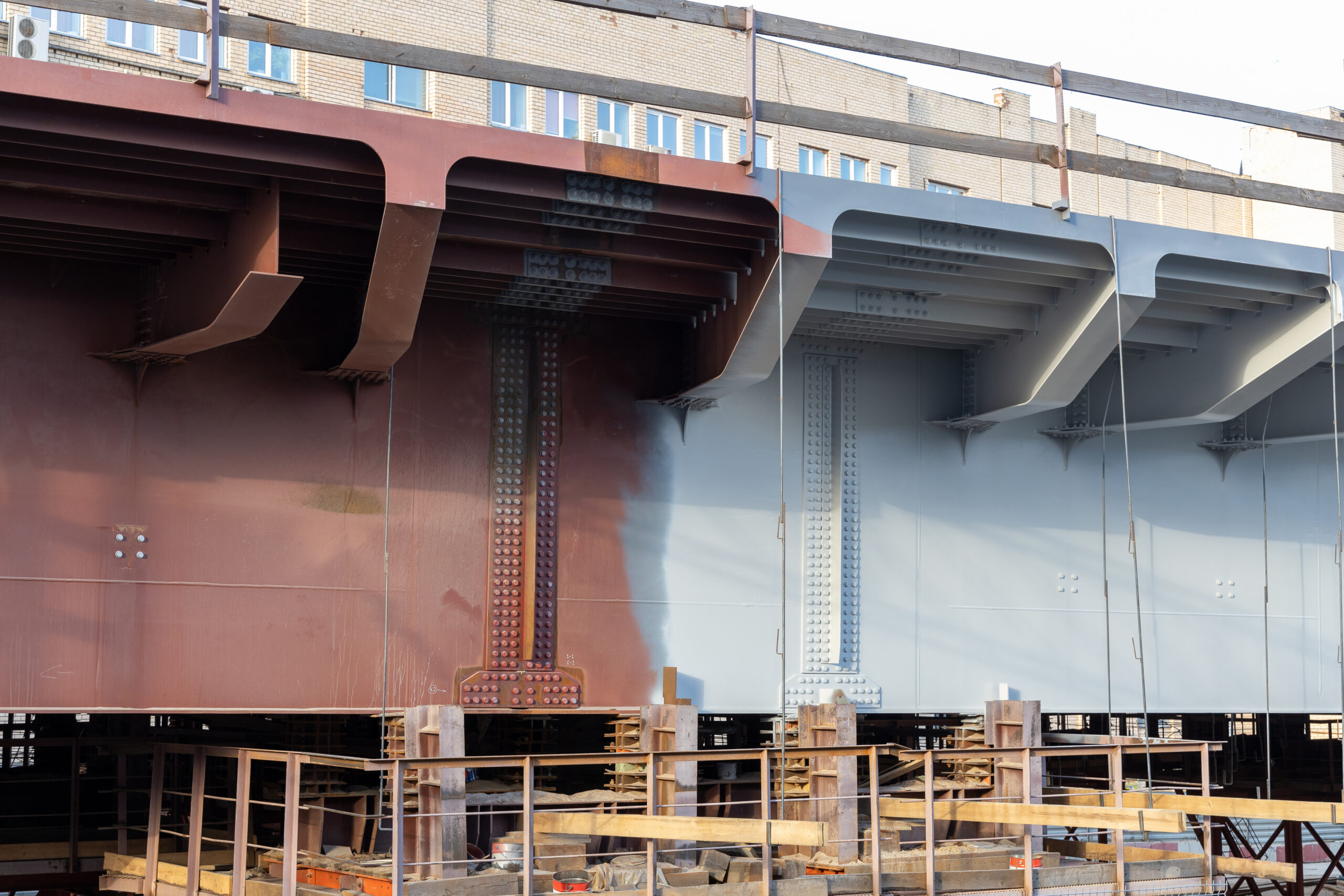
Bridge and protective coating work does not price like simple paint work
This is where the page should visually connect pricing logic to real-world access, containment, weather exposure, and steel geometry. The second image works well here because it reinforces the point that protective coating pricing depends on conditions, not just quantity.
This section is also a natural place to link to your pillar page and related content about industrial coating estimating, marine coating estimating, surface profile, and Dry Film Thickness (DFT).
Geometry Multipliers
Price webs, edges, internals, and hard-to-reach surfaces differently than flat plate.
Environmental Windows
Forecast dew point, humidity, and wind-related production drag before margin disappears.
Containment and Air Exchange
Keep dehumidification, dust collection, and environmental controls visible in pricing logic.
Mobilization Burn
Do not give away daily setup, teardown, safety checks, and move-time for free.
How it works
A clearer pricing flow for protective coating contractors
01
Input your cost floor
Load overhead, labor burden, G&A, wages, field and shop ratios, and support structure so pricing never dips below your actual breakeven.
02
Select coating systems
Define primer, stripe, intermediate, and topcoat sequences while accounting for surface profile and DFT-driven material behavior.
03
Apply difficulty factors
Adjust price for access, height, containment, geometry, and environmental controls so the labor side reflects field reality.
04
Model the forecast
See how weather drag, mobilization loss, waste factors, and pass-through markup affect the final bid before you submit it.
Bid defense checklist
Stop defending a price and start defending a process
Substrate and surface prep logic
- Have you adjusted material volume for dead volume in the anchor pattern?
- Does the labor rate reflect the actual cleanliness spec, such as SP-10 versus SP-6?
- Is abrasive disposal and environmental fee handling included in prep pricing?
Environmental and burn-rate forecasting
- Have you modeled production drag for humidity and restricted application windows?
- Does the price account for induction time on multi-component systems?
- Are containment and air-exchange costs isolated instead of buried?
Material reality factors
- Did you adjust for wind loss, overspray, and difficult geometry?
- Does pricing include extra material needed to confidently achieve DFT minimums?
- Have you priced waste from fast-cure coatings and pot life expiry?
Access and mobilization
- Is price per square foot higher in difficult access zones like webs, internals, and tight members?
- Does burn rate include daily safety checks, setup, and move-time?
- Have you accounted for rigging, containment adjustment, and jobsite reset loss?
FAQ
Questions buyers and estimators ask about protective coating pricing software
How is protective coating pricing software different from basic estimating software?
Basic estimating software often stops at quantity and markup. Protective coating pricing software should show labor burden, indirect cost structure, pass-through COGS logic, waste factors, technical specs, and combined profit margin in a way that is easier to explain and defend.
How does pricing software account for Dry Film Thickness (DFT)?
It should help estimators think beyond theoretical coverage by considering profile fill, actual yield, and extra material needed to meet minimum thickness requirements in real field conditions.
Why should labor markup and material markup be separated?
Because labor is usually the more volatile and risk-sensitive part of the estimate. Expensive coatings and other pass-through items may need a different markup strategy so the bid stays competitive without hiding labor risk.
Can pricing software help defend a higher bid?
Yes. A better pricing framework shows how the number was built and why access, prep intensity, environment, mobilization, and waste factors change the cost. That makes the estimate easier to justify in front of owners and primes.
BreakEven+™
Price protective coating work with more control, more clarity, and less guesswork
BreakEven+™ helps contractors move from spreadsheet assumptions to a disciplined pricing framework that makes breakeven, sell rate, markup, and final margin easier to understand.